
What's happening with Saulaine?
There are a lot of conversations, rumours and falsehoods in the Latvian community about what’s happening at Saulaine. So, to clarify things …
Like many Latvian organizations not only in Toronto but elsewhere in Canada and the United States, the St. John’s Evangelical Lutheran Latvian Church in Toronto has financial challenges. In order to balance the annual budget, it has to dip into the Church’s capital funds, savings that have been built over time, partly thanks to the generous testamentary donations of past congregation members.
As a result, the Church has been able to balance its books for some time but if things don’t change, the moment will soon come when funds will have been depleted. Anticipating that situation, several years ago the Council of the Church, formed a strategic planning committee to assess the current situation and identify future possibilities.
After a thorough job and consultations with the leadership of the Church and its members, as well as several Town Hall meetings, the committee has put forward the recommendation to sell the Church’s rural property Saulaine. Council has approved the recommendation. Over the last twenty years, Saulaine has incurred huge deficits for the Church to cover annual losses as well as capital expenditures for upgrades, all to the tune of almost two million dollars. That doesn’t include future capital investments required for upgrades. By selling Saulaine, the Church would receive a significant amount of funds that would give it financial respite and its future would not be endangered.
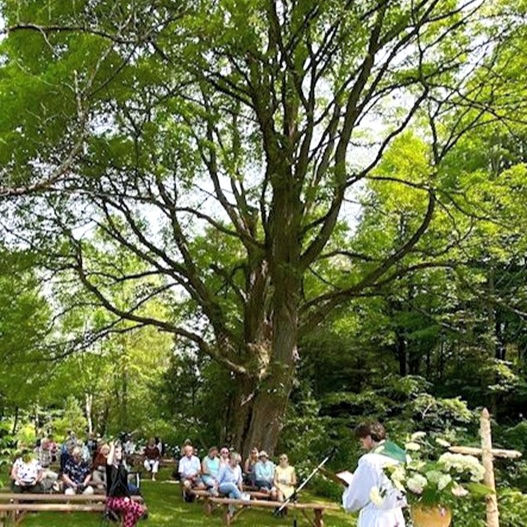
Saulaine was purchased by the Church in 1952 as a rural retreat, an escape from the city air and noise, for members of the congregation particularly its children and youth. Over the course of time, Saulaine has hosted summer camps, various seminars and gatherings, events, and of course Jani celebrations which in its heyday attracted up to 2,000 participants.
Today, there is little usage of Saulaine by the Church and Latvian community. There are several events during the year, the Fall Festival, Jani, which are deemed a success if they attract even more than a hundred participants. There are other smaller events, for example the commemoration of Latvian soldiers in March and November as well as religious retreats. Summer camps are no longer held. With the lack of events and decreased corresponding income, facility rentals, for example weddings, usually to non-Latvians, have been unable to cover the short-fall.
The conclusion … Saulaine is no longer core to the life of the Church and on top of that, results in large financial losses.
The Council understands that the decision to sell Saulaine is a difficult one for members of the congregation tied to their emotions and memories. But the deciding question is the survival of the Church.
Opposition, criticism and in fact remarks that could be construed as offensive, have been made in private conversations and social media against the sale. Unfounded arguments have been levelled often from people who have no connection to the Church but who like to speculate from points near and far. It is important to remember that Saulaine is owned by the Church rather than the Latvian community-at-large. It will be members of the congregation who will decide Saulaine’s future.
One of the criticisms is that by selling Saulaine, the Church is not considering the needs and future of the Latvian community in the Toronto area. That’s not the case. In fact, the opposite is true. By selling Saulaine and enabling the Church to survive and keep its beautiful church building in a green and shady area of Toronto, the wider Latvian community is being served. The physical church is not just the home and place of worship for St. John’s, but it is also the home of our sister St. Andrew’s Latvian Lutheran congregation. The church has excellent acoustics and has hosted more and more Latvian concerts. The church’s intimate hall has seen increased community usage for smaller events. Recently the Latvian Saturday School and the arts exhibit organized by the Latvian youth organization LNJAK were held at the church. And even today, Toronto is the largest overseas Latvian diaspora community. It would be difficult to imagine that its Latvians would no longer have a church.
Others have said, sell the church and keep Saulaine. Supposedly, services could be held at the Latvian Centre as is the case with a Chinese Baptist congregation which rents the Centre not just on Sundays but throughout the week. Even hold services outdoors. After all, it’s not important where you worship. But how is it that there are millions and millions of churches, temples, synagogues and mosques, where the religious find a place of peace and piety. It is arrogant to suggest that the congregation go to the empty, bare and unattractive rooms of the Centre.
It has been suggested to sell Saulaine at a deep discount to a group of Latvians so that the property stays in the hands of Latvians. That would be great and Council would be receptive to that suggestion, but the price would have to be market value. Otherwise, the Church’s status as a not-for-profit organization and ability to issue tax receipts to donours would be compromised. The Church cannot allow that.
And what if Saulaine was sold at a deep discount? What would happen in a few years if the new owners could not sustain the property and had to sell, this time at market value? Someone would make a tidy profit.
Others have suggested that Saulaine be converted to be primarily a Canadian event destination in order to generate revenue. Sure, Saulaine hosts non-Latvian weddings and events but in order to upgrade the facilities at Saulaine to meet the standards expected by today’s clientele, it would require huge investments to ensure that it could compete in the open market. But the mission of the Church is not to run a side business and that too could compromise its not-for-profit status.
It is also important to remember that the church itself is ageing and needs monies for upgrades and maintenance.
Others have claimed that by selling Saulaine, the ecology of the property would be endangered. This is not true because roughly half of the property, specifically the floodplain, is already subject to local conservation area regulations. Its ecological future is protected.
It has been suggested that we need to engage Toronto area Estonians and Lithuanians to convert Saulaine into a Baltic community retreat. But the Estonians and Lithuanians already have a number of rural properties and camps. Why should they all of a sudden run to help Saulaine?
Yes, there are various ideas out there but it is not enough to throw them out and expect someone else to run with them. Those with ideas also need to work through and detail them to prove that they are realistic, sustainable and would address the challenges facing the Church, namely to ensure its survival, and then to enact them.
Saulaine has served St. John’s Church and the Toronto Latvian community for decades. Sincere thanks to the many who have visited Saulaine and spent countless hours on its upkeep. But everything points to the fact, that in order for the Church to survive, for Latvians to have a place of worship in Toronto, congregation members have no option other than selling Saulaine.
Viesturs Zarins
St. John’s Lutheran Latvian Church Council member


Comments